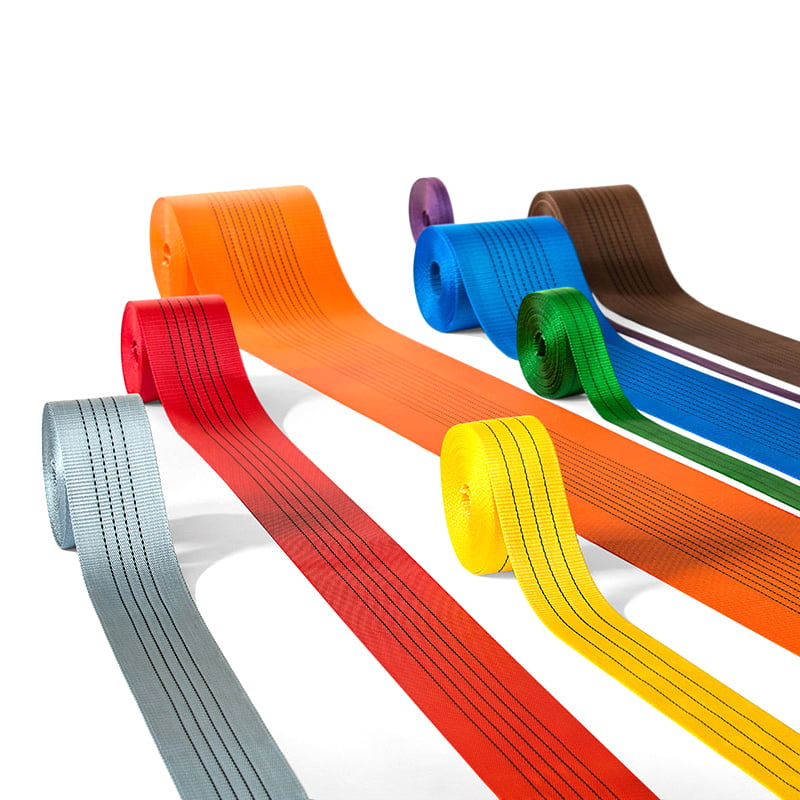
Welcome to Oppermann, we are a leading provider of diversified and multi-category webbing solutions.
Welcome to Oppermann, we are a leading provider of diversified and multi-category webbing solutions.
2026-06-17
Content
When a flatbed driver cinches down a 20‑ton coil of steel, the strap isn’t just a piece of webbing—it’s the difference between a secure haul and a catastrophic runaway. Flat bed straps are the heavy‑duty tie‑downs engineered specifically for flatbed trailers, designed to handle everything from lumber to mining equipment. The most common types are winch straps and ratchet straps, each with distinct mechanics and best‑use scenarios.
A winch strap pairs with a winch permanently mounted to the trailer’s side rail. The strap is fed through the winch mandrel, then tightened with a winch bar. This setup lets experienced operators secure a load in 30–40% less time than a ratchet mechanism. A ratchet strap, by contrast, integrates the tightening mechanism into the strap assembly—no trailer‑mounted winch needed. That portability makes ratchet straps popular for small fleets, rental trucks, and enclosed trailers, but they are slower per tie‑down and demand more physical effort per cycle.
For extreme loads, some operators turn to chain binders, but web straps dominate flatbed cargo because they are lighter, reduce damage to cargo surfaces, and meet FMCSA requirements with proper WLL ratings. Understanding the difference between winch and ratchet systems is the first step to choosing the right flat bed straps for your operation.
| Feature | Winch Strap | Ratchet Strap |
|---|---|---|
| Tightening mechanism | Trailer‑side winch + winch bar | Integrated ratchet handle |
| Speed of application | Fast; secures in single motion | Slower; requires multiple handle cycles |
| Tension precision | Moderate | High; click‑stop locking |
| Portability | Requires winch on trailer | Self‑contained; use on any anchor point |
| Typical load range | Heavy flatbed loads; 2″–4″ widths | Medium‑duty; common up to 4″ width |
| Common WLL (4″ strap) | 1,800 lbs (breaking strength 5,400 lbs) | 1,800 lbs (breaking strength 5,400 lbs) |
The width of a flat bed strap directly determines its working load limit (WLL). Under FMCSA 49 CFR Part 393, the WLL of a web strap is calculated by dividing the breaking strength by 3. So wider webbing isn’t just a visual cue—it’s a legal and mechanical line between safe and unsafe cargo securement.
Here’s how the three most common widths stack up in real‑world flatbed operations. A 2‑inch strap typically carries a WLL of 667 lbs and handles light materials like drywall or small pallets. A 3‑inch strap at 1,000 lbs WLL bridges the gap for medium machinery and bundled pipe. The workhorse 4‑inch strap, with a 1,800 lbs WLL, anchors heavy steel coils, large crates, and construction equipment.
Length is equally practical. Straps come in lengths from 20 ft to 40 ft and beyond. The rule of thumb: the strap must fully wrap the cargo and still leave enough tail to engage the winch or ratchet with at least two full wraps on the mandrel. Underestimating length leads to unsafe tie‑downs; overestimating wastes money and creates tangles.
| Strap Width | Typical Breaking Strength | WLL (÷3) | Recommended Cargo Weight (example) |
|---|---|---|---|
| 2″ | 2,000 lbs | 667 lbs | Lumber bundles up to 2,000 lbs, drywall, light pallets |
| 3″ | 3,000 lbs | 1,000 lbs | Medium machinery, bundled pipe, crates up to 3,000 lbs |
| 4″ | 5,400 lbs | 1,800 lbs | Steel coils, heavy equipment, construction materials |
Always match strap WLL to the actual cargo weight—not the trailer capacity. A 10,000‑lb load needs at least 5,000 lbs of aggregate WLL, which means three 4‑inch straps (3 × 1,800 = 5,400 lbs) or five 2‑inch straps.
The fiber inside your strap decides how it reacts to sun, rain, road grit, and sudden loads. While polyester has become the standard for flat bed straps, some suppliers still offer nylon or ultra‑high‑molecular‑weight polyethylene (UHMWPE). Each behaves differently under the stresses of daily flatbed work.
Polyester webbing resists UV degradation, absorbs almost no water, and stretches only 3–5% at typical working tension. That low elongation means the strap holds its shape and keeps cargo from shifting. Nylon, by contrast, can stretch up to 25% at break and absorbs up to 9% of its weight in water, causing it to sag and lose strength. UHMWPE offers near‑zero stretch and exceptional cut resistance, but costs three to five times as much as polyester.
For most trucking operations, the math is simple: polyester provides the best balance of safety, durability, and cost. Unless you need extreme cut protection or ultra‑lightweight straps for specific air‑transport containers, polyester stands as the baseline. If you’re sourcing bulk webbing for custom straps, starting with high‑tenacity polyester yarns is essential—our polyester webbing sling line is engineered to meet those exact flatbed demands.
| Property | Polyester | Nylon | UHMWPE |
|---|---|---|---|
| UV resistance | Excellent | Poor (requires coating) | Excellent |
| Stretch under WLL | 3–5% | 6–12% | <1% |
| Water absorption | Negligible | Up to 9% by weight | None |
| Abrasion resistance | Good | Very good | Excellent |
| Relative cost | Low | Moderate | High (3–5× polyester) |
Stretch control is a safety factor, not a comfort feature. A strap that elongates more than 6% under load allows the cargo to walk, risking load shift and roadside violations. ASTM D6775 provides standardized test methods for webbing elongation; specifying webbing that meets a sub‑5% stretch at working load is a practical target for most U.S. flatbed fleets.
Roadside inspectors don’t care about brands—they care about math. FMCSA 49 CFR Part 393 lays out clear numerical requirements for flatbed cargo securement. The core rule: the aggregate WLL of all tie‑downs used on an article must be at least 50% of the article’s weight. For cargo not prevented from forward movement by a headerboard or bulkhead, that requirement steps up to 80% in the forward direction for certain configurations, but the general 50% rule governs most flatbed loads.
Here’s how to apply it in three steps. First, weigh or obtain the actual cargo weight. Second, divide that weight by two. Third, divide the result by the WLL of your chosen strap, then round up. A 12,000‑lb machine needs at least 6,000 lbs of aggregate WLL—meaning four 4‑inch straps (1,800 lbs each) or seven 2‑inch straps. You must also observe the minimum number rule: at least one tie‑down for every 10 linear feet, and never fewer than two tie‑downs per article under 5 feet.
Edge protection is mandatory when a strap crosses an edge with a radius less than 1/2 inch. Without protection, a strap can lose up to 50% of its breaking strength on a sharp steel corner. Simple rubber or polyurethane corner protectors at least 1/4 inch thick restore compliance and prevent catastrophic failure. Adding sling wear pads or dedicated edge protection is a low‑cost way to extend strap life and meet the letter of the law.
Pre‑trip inspection is legally required. You must check every strap for cuts, abrasion, UV damage, chemical exposure, and compromised stitching before the vehicle moves. A strap that shows any sign of structural fatigue must be removed from service immediately—no exceptions.
Straps alone don’t make a load safe—technique does. Each cargo type demands a specific combination of blocking, bracing, and tie‑down angles. Below are practical methods for five of the most frequent flatbed loads, based on FMCSA best practices and field experience.
Off‑the‑shelf 4″ x 30′ winch straps cover 80% of flatbed operations. But for fleets that run the same cargo day after day, custom flat bed straps deliver lower total cost of ownership and fewer roadside headaches. The difference often lies in the details: exact length, abrasion‑resistant coatings, and end fittings that match your trailer hardware perfectly.
A standard strap may cost less upfront, but if it’s 5 feet too long, the excess tangles, gets caught on debris, and wears faster. A custom strap cut to your trailer’s exact rail spacing eliminates that waste. Similarly, adding a wear‑resistant PU coating can double or triple webbing life in abrasive environments, while color coding allows instant identification of WLL ratings across a fleet.
The cost trade‑off isn’t linear. A premium custom strap might carry a 20–30% higher initial price, but its extended service life means fewer replacements and less downtime. For heavy‑duty tie‑downs where reliability is non‑negotiable, American-style tie-down webbing built to your exact load and trailer specs often pays for itself within the first year of use.
| Cost Factor | Standard Strap | Custom Strap (PU‑coated, exact length) |
|---|---|---|
| Initial unit price | $40–45 | $52–58 |
| Typical lifespan under heavy use | 8–12 months | 24–36 months |
| Replacements over 3 years | 2–3 | 0–1 |
| Total cost per strap (3 years) | $120–135 | $52–58 (one replacement scenario) |
| TCO savings per strap | — | 55–60% |
The sweet spot for customization emerges when replacement cycles outpace initial cost. If your fleet replaces standard straps twice a year, moving to a custom solution with double the service life can cut strap spending in half while reducing the risk of roadside violations.
A flat bed strap doesn’t fail on the highway without warning—it gives plenty of signals during pre‑trip and post‑trip checks. The challenge is knowing what to look for and treating inspection as a non‑negotiable routine, not a rushed formality.
Start with the webbing. Run your hand along the full length, feeling for cuts, melted fibers, or hard spots that indicate chemical attack. Look for chalky white residue—a telltale sign of UV degradation that weakens polyester by 30% or more before it snaps. Check every inch of stitching; if more than two consecutive stitches are broken, retire the strap. On the hardware side, inspect hooks, winch mandrels, and ratchet pawls for cracks, bending, or corrosion that could slip under load.
Strap storage matters more than most drivers realize. Straps left in direct sunlight or in contact with diesel and hydraulic fluid degrade silently. Coil each strap after use and store in a dry, covered compartment. Use strap retainers or rubber bands to prevent the wound strap from loosening and creating tangles that accelerate wear.
A practical replacement schedule backs up visual inspections. For high‑mileage flatbed operations, swap out straps every six months, regardless of appearance. For lower‑frequency use, a 12‑month maximum serves as a safe cutoff. Document each replacement and align it with your fleet maintenance software to build a paper trail in case of an audit.
No strap is “good enough” once it shows structural fatigue. The cost of a new 4‑inch winch strap is a fraction of a cargo‑shift fine or liability claim. Build edge protection into your standard kit, because even new straps fail fast without it.
Recommended Products

Copyright © 2025 Oppermann Safety Webbing (Kunshan) Co., Ltd. All Rights Reserved. Polyester Webbing Supplier



 English
 русский
 Español
 عربى
عربى