Welcome to Oppermann, we are a leading provider of diversified and multi-category webbing solutions.
Welcome to Oppermann, we are a leading provider of diversified and multi-category webbing solutions.
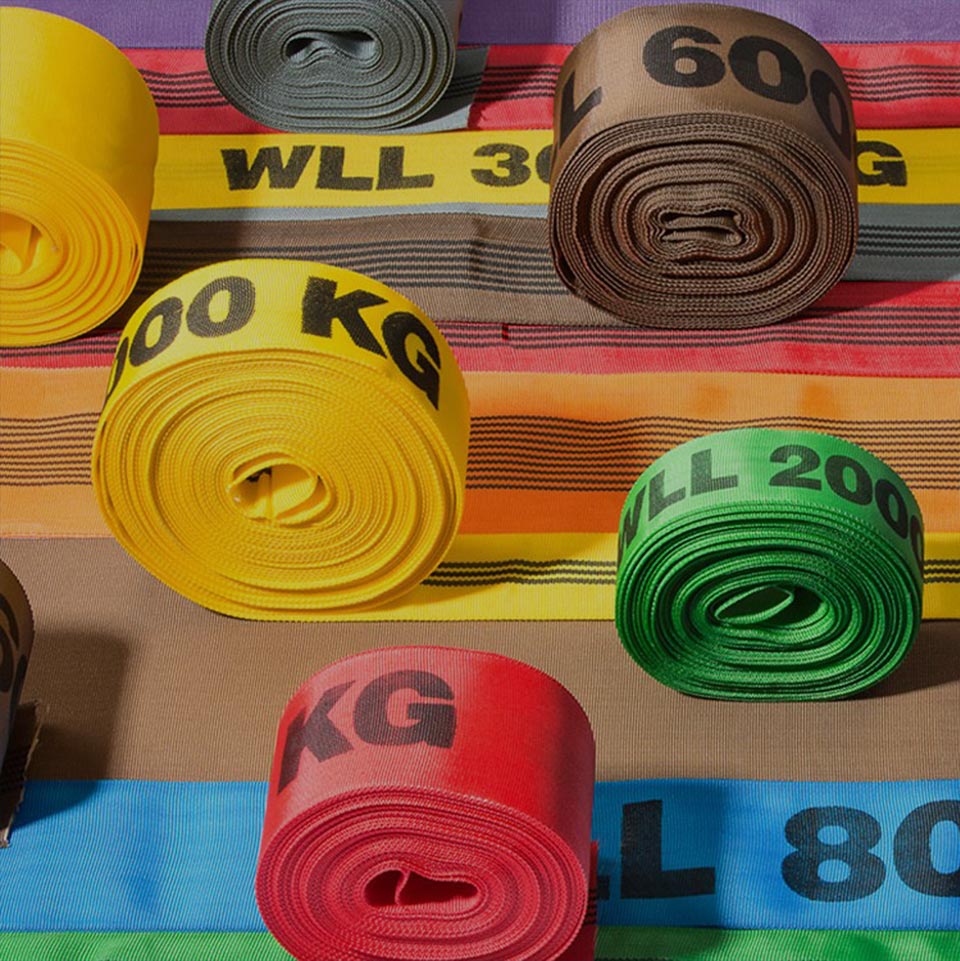
Polyester lashing webbing is the engineered base material for manufacturing cargo securing assemblies such as ratchet tie-downs, winch straps, and other restraint systems. Supplied in bulk rolls or bulk boxes, it allows manufacturers to cut to length and sew finished products with repeatable performance. Safety note: cargo lashing webbings are intended for cargo securing and are not interchangeable with lifting webbings.
To reduce variation in high-volume production, our webbing is woven with uniform warp/weft density and a surface free of knots or weak points, helping ensure each cut segment maintains its nominal strength. We offer multiple standard widths plus customization (warning stripes / corporate colors), and batch tensile testing is performed before shipment. Choose the series by your target market standard: EN 12195-2 (Europe) or (WSTDA)-T-1 (North America).
Oppermann Safety Webbing (Kunshan) Co., Ltd. is a foreign sole legal person enterprise, is the second wholly-owned subsidiary of Oppermann Group in China.
The second wholly-owned subsidiary of Oppermann Group in China. Oppermann is constantly striving to utilize the latest high tech fibers, the most advanced weaving techniques and the latest dyeing technology in its manufacturing process. As
Polyester Lashing Webbing Manufacturers and Polyester Lashing Webbing Factory, Oppermann′s products include tie down webbing, lifting sling webbing, safety harness and seat belt webbing, static conductive webbing, military webbings and child restraint webbing.
Our company is mainly engaged in the production and sales of engineering special textiles and all kinds of special-purpose webbing, for civil industry, military industry, aerospace, land and ocean transportation, to provide a variety of conventional and special performance webbing. Polyester Lashing Webbing Wholesale. The annual production of various series of webbing products for total is about 4000 tons.


A 2-inch stake pocket looks identical to a 3-inch pocket from three feet away. Buy the wrong bracket, and you will not discover the mistake...
View MoreA procurement officer sifts through a stack of specifications for Humvee tie-downs and spots the number 5340-01-504-2426. Without understan...
View MoreA full 55-gallon drum weighs more than 400 pounds. At highway speed, a sudden lane change can turn that drum into a 2,000-pound projectile....
View MoreWhat Is Military Cargo Netting? A cargo net that fails at 10,000 feet doesn’t just lose its payload — it jeopardizes the mission, the aircr...
View MoreOur customization work always begins with one non-negotiable question: which market standard are you building to—EN 12195-2 (Europe) or WSTDA-T-1 (North America)? The standard determines the accepted test approach, the performance expectations, and the “language” your customers will audit against.
Safety boundary: lashing webbing is engineered for cargo securing and should not be positioned or re-purposed as lifting webbing. Clear positioning protects your end users and reduces compliance risk.
For converters making ratchet tie-downs or winch straps, consistency matters as much as nominal strength. Our approach is to define a small set of “must-control” parameters and keep them stable across repeat orders—especially when you are cutting hundreds or thousands of segments per batch.
| Parameter | EU program (EN 12195-2) | NA program (WSTDA-T-1) | Customization focus |
|---|---|---|---|
| Sizing convention | Metric widths (commonly 25 / 35 / 50 / 75 mm) | Imperial widths (commonly 2" / 3" / 4") | Match your cutters, sewing guides, and hardware dimensions |
| Strength tier | Breaking strength tiers aligned to your LC program | Common breaking strength tiers from 6,000 to 24,000 lbs | Define minimum breaking strength and keep a stable construction |
| Elongation control | Often specified with controlled stretch to reduce settling | Commonly targeted at <7% | Balance low stretch with durability for transport vibration |
| Color & ID | Multi-color stripes and RAL color references are common | Classic yellow is common; ID lines and custom colors available | Use repeatable color references (e.g., RAL) and fixed stripe patterns |
| Supply format | Bulk rolls for downstream sewing/assembly | Bulk rolls (or bulk packing) for converters | Align roll length, core, and labeling to your shop-floor workflow |
Behind the numbers, we prioritize a stable weave structure (uniform warp/weft density) and a clean surface free of weak points, so every cut length behaves predictably during sewing and in service.
Customization is not only about “making it fit”—it is also about making it identifiable. For lashing webbing, identification must remain clear after abrasion, weather exposure, and repeated tensioning cycles.
Our rule of thumb: branding should improve traceability, not introduce variability. If a visual feature could affect cutting, sewing, or inspection, we validate it during sampling instead of “fixing it later” in production.
We treat customization as an engineering change process, not a one-off color request. The goal is to help you scale from trial quantities to stable, high-volume production with minimal variation between lots.
To support consistent outcomes, we perform batch tensile testing before shipment and keep production aligned to the approved construction parameters. The result is a webbing supply that converters can trust for repeatable assembly performance.
A technically correct webbing can still create cost if it arrives in the wrong format. That’s why we treat packaging and labeling as part of customization—not an afterthought.
If confidentiality is required for a private-label program, NDA support is available. For the fastest quotation and sampling kickoff, share your required breaking strength, width, quantity, and destination country.

Copyright © 2025 Oppermann Safety Webbing (Kunshan) Co., Ltd. All Rights Reserved. Polyester Lashing Webbing Factory



 English
 русский
 Español
 عربى
عربى

