Welcome to Oppermann, we are a leading provider of diversified and multi-category webbing solutions.
Welcome to Oppermann, we are a leading provider of diversified and multi-category webbing solutions.
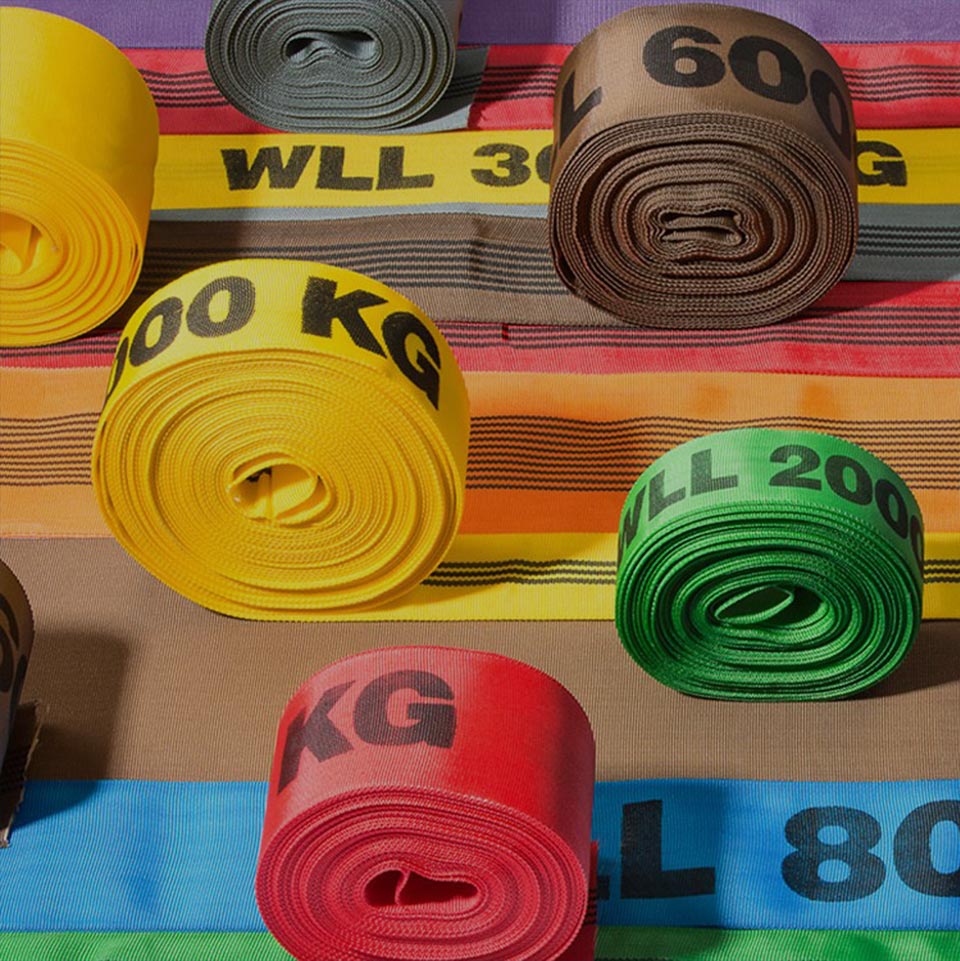
This category features polyester sling webbing (raw material) supplied in rolls for downstream cutting and sewing. It is intended for manufacturing flat webbing slings and related lifting products.
We offer market-oriented series for Europe, North America, and Australia, with specification and identification options aligned to common local practices (e.g., color coding, labeling, and traceability). Breaking strength and elongation targets are provided by series to support consistent production control.
For a faster quotation, please specify your destination market/program, required width & thickness, color preference, and the end-product type you plan to manufacture (e.g., eye-and-eye or endless). Final WLL depends on the finished sling design and manufacturing method.
Oppermann Safety Webbing (Kunshan) Co., Ltd. is a foreign sole legal person enterprise, is the second wholly-owned subsidiary of Oppermann Group in China.
The second wholly-owned subsidiary of Oppermann Group in China. Oppermann is constantly striving to utilize the latest high tech fibers, the most advanced weaving techniques and the latest dyeing technology in its manufacturing process. As
Flat Polyester Webbing Sling Manufacturers and Polyester Heavy Duty Flat Webbing Factory, Oppermann′s products include tie down webbing, lifting sling webbing, safety harness and seat belt webbing, static conductive webbing, military webbings and child restraint webbing.
Our company is mainly engaged in the production and sales of engineering special textiles and all kinds of special-purpose webbing, for civil industry, military industry, aerospace, land and ocean transportation, to provide a variety of conventional and special performance webbing. Wholesale Polyester Flat Webbing Sling. The annual production of various series of webbing products for total is about 4000 tons.


A 2-inch stake pocket looks identical to a 3-inch pocket from three feet away. Buy the wrong bracket, and you will not discover the mistake...
View MoreA procurement officer sifts through a stack of specifications for Humvee tie-downs and spots the number 5340-01-504-2426. Without understan...
View MoreA full 55-gallon drum weighs more than 400 pounds. At highway speed, a sudden lane change can turn that drum into a 2,000-pound projectile....
View MoreWhat Is Military Cargo Netting? A cargo net that fails at 10,000 feet doesn’t just lose its payload — it jeopardizes the mission, the aircr...
View MoreWhen we customize polyester webbing slings, we start from the safety language your customers will inspect: WLL (Working Load Limit), not “breaking strength.” This aligns the sling’s design, labeling, and verification with real lifting practice and helps reduce misuse risk.
We also align each program to its market framework, because regional expectations differ (e.g., EN 1492 in the EU, OSHA/ASME practices in North America, and AS 1353 in Australia). Matching the right framework early prevents label rework and acceptance delays.
A webbing sling must deliver repeatable behavior within the rated load range. Our customization approach is to lock the construction variables that drive consistency: yarn selection, weave density, edge build-up, and finishing. The goal is reliable tensile performance with low elongation to help reduce shock during lifting.
We avoid “hidden weak points” by controlling webbing uniformity across the full length—this is especially important for slings intended to be manufactured without joints and engineered to distribute force evenly.
Many sling failures in the field are not caused by the webbing body, but by end construction, stitching quality, and abrasion at the eyes. We treat end design as a primary customization item, not a downstream detail.
Process control focus: we standardize sewing thread selection, stitch density, and reinforcement placement during sampling so repeat orders remain visually and mechanically consistent.
In lifting operations, labeling is not marketing—it is a safety control. We customize labels to match local expectations and your internal traceability rules, so every sling can be identified, verified, and managed across its service life.
| Item | Why it matters | Typical options |
|---|---|---|
| WLL display | Defines permissible load by method/angle | Vertical / Choker / Basket; angle factors |
| Market framework | Aligns acceptance expectations and label format | EN 1492 (EU) / OSHA-ASME (NA) / AS 1353 (AU) |
| Units and language | Reduces misread risk across sites | kg / t / lb; bilingual tags |
| Traceability | Enables batch control and lifecycle management | Batch/serial no.; inspection instructions |
| Color coding | Fast visual sorting and wrong-sling prevention | Regional color practice; customer private-label palette |
Customization principle: labels must remain readable after abrasion and handling; we prioritize durable tag materials and stable printing methods over “pretty” designs that degrade quickly.
For lifting products, customization is only complete when verification and delivery are defined. We produce to applicable lifting safety requirements and perform rigorous load verification so each sling meets its rated capacity requirements before shipment.
If you are building a private-label line, NDA support is available. For the fastest RFQ, share the target WLL, sling type, length, quantity, and destination country so we can align your program to the correct market format.

Copyright © 2025 Oppermann Safety Webbing (Kunshan) Co., Ltd. All Rights Reserved. Heavy Duty Flat Polyester Webbing Sling Manufacturers



 English
 русский
 Español
 عربى
عربى


