Welcome to Oppermann, we are a leading provider of diversified and multi-category webbing solutions.
Welcome to Oppermann, we are a leading provider of diversified and multi-category webbing solutions.
2026-01-16
Content
No—synthetic fiber slings should not be used to hoist personnel baskets when they serve as the suspension bridle. For suspended personnel platforms (personnel baskets), follow personnel-hoisting rules and use a purpose-designed, dedicated suspension system—typically wire rope bridle/rigging hardware that meets the required safety margins.
The practical takeaway is straightforward: if a sling is part of the load-bearing connection between the crane/hoist line and the personnel basket, select rigging intended for personnel lifting and verify it meets the applicable factors, inspections, and dedicated-use requirements.
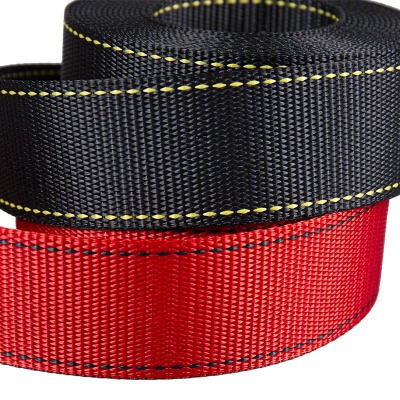
Hoisting people is not “just another lift.” Personnel baskets (personnel platforms) are governed by stricter requirements because a single component failure can be fatal. The suspension system is expected to be: highly damage-tolerant, resistant to cutting/abrasion, and controlled under dynamic movement (swing, snag, wind, and minor shock loading).
Synthetic fiber slings (including synthetic webbing slings and synthetic fiber rope slings) are widely used for material handling, but personnel-hoisting introduces a critical limitation: OSHA guidance explicitly warns against using synthetic webbing slings or synthetic rope slings as bridles on suspended personnel platforms.
| Sling / Rigging Type | Use as Basket Suspension Bridle? | Practical Rationale |
|---|---|---|
| Synthetic web sling | No (avoid for personnel-platform bridles) | OSHA guidance warns against webbing slings as personnel-platform bridles; high cut/abrasion sensitivity |
| Synthetic fiber rope sling | No (avoid for personnel-platform bridles) | OSHA guidance warns against synthetic rope slings as personnel-platform bridles; degradation can be difficult to detect |
| Wire rope bridle (purpose-built) | Commonly used | Good damage tolerance; compatible with personnel-hoisting rigging practices and inspection criteria |
| Rated rigging hardware (master links, shackles, hooks) | Required | Must meet personnel-hoisting strength and locking requirements |
For personnel baskets, select a suspension system that satisfies the personnel-hoisting standard for your jurisdiction and site. In OSHA-covered construction hoisting, a key requirement is that rigging hardware and hooks be capable of supporting, without failure, at least five times the maximum intended load applied to that component (and higher in certain rope configurations).
Suppose the personnel basket weighs 400 lb, two occupants weigh 250 lb each (500 lb), and tools/materials total 100 lb. The maximum intended load is 400 + 500 + 100 = 1,000 lb. Under a 5:1 requirement, each component in the load path must be capable of supporting without failure at least 5,000 lb of the load applied to it (and you must still account for sling angles, load distribution across bridle legs, and any manufacturer deratings).
A compliant personnel lift is a procedure, not just a connection. Use a competent/qualified person per your site rules to verify the full lift plan, and apply a repeatable pre-lift checklist.
If the only available slings are synthetic fiber slings, the safe answer is to stop and source the correct personnel-rated suspension system. Personnel hoisting is not the place for substitutions based on convenience or stock availability.
Synthetic slings may be appropriate for separate material-handling tasks, but they should not be used as the load-bearing bridle suspending a personnel basket. Keep the personnel-hoisting rigging segregated, identified, and dedicated to that purpose.
Bottom line: for hoisting personnel baskets, use a personnel-hoisting suspension system and procedure; do not rely on synthetic fiber slings as the basket bridle.
Recommended Products

Copyright © 2025 Oppermann Safety Webbing (Kunshan) Co., Ltd. All Rights Reserved. Polyester Webbing Supplier



 English
 русский
 Español
 عربى
عربى


